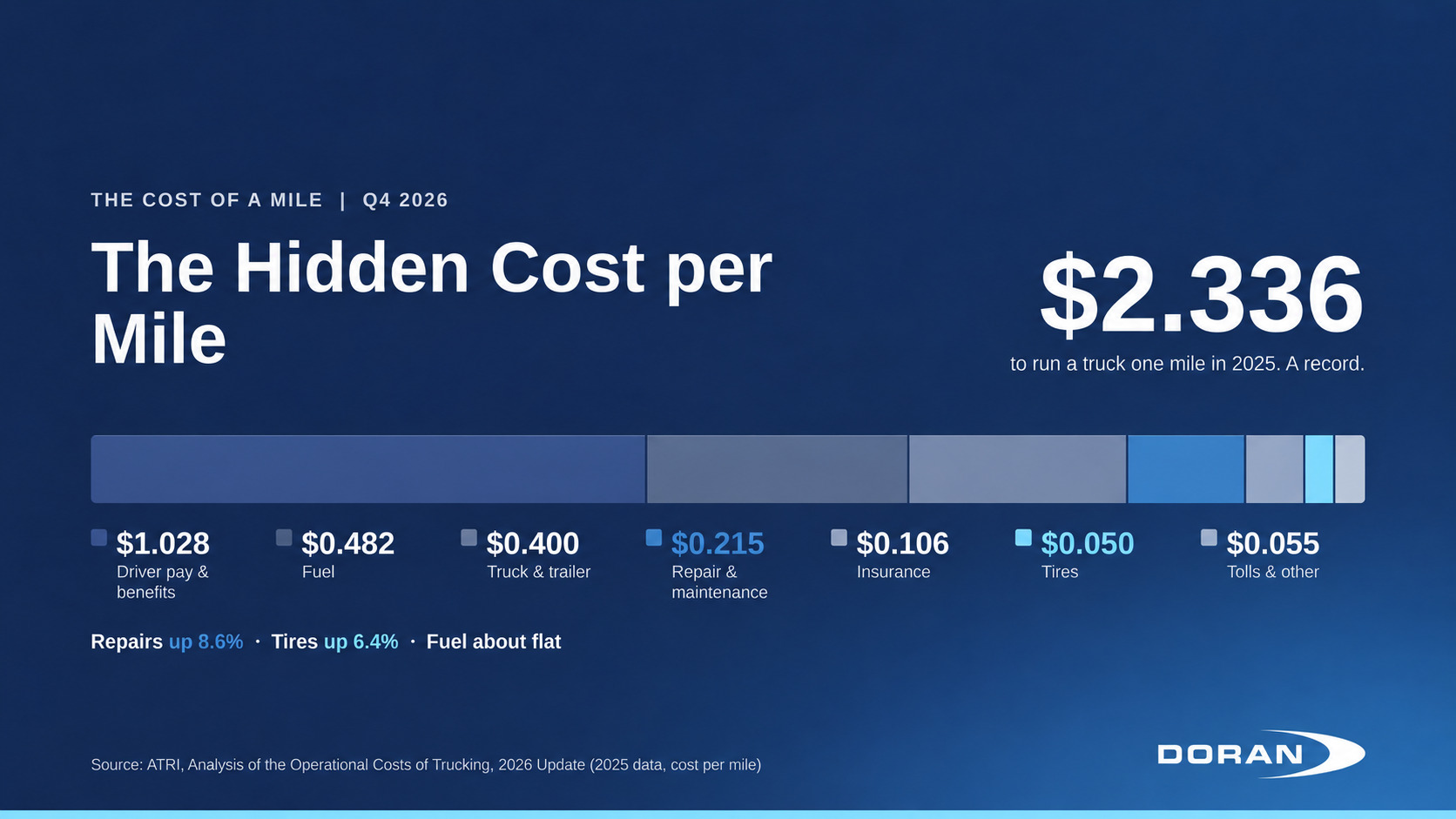
It has never cost more to run a truck. The American Transportation Research Institute (ATRI) found the average cost to operate a truck in 2025 was $2.336 per mile, the highest in the history of its report.
With diesel over $6 this fall, it's easy to blame the pump. But here's the surprise: in 2025, fuel was one of only two cost lines that grew slower than inflation. Take fuel out, and costs still climbed 4.2% to a record $1.854 per mile.
Here's where each dollar of that mile went:
| Cost line | Per mile, 2025 | Change from 2024 |
|---|---|---|
| Driver wages and benefits | $1.028 | up 3.3% |
| Fuel | $0.482 | about flat |
| Truck and trailer payments | $0.40 | up 3.6% |
| Repair and maintenance | $0.215 | up 8.6% |
| Insurance | $0.106 | up 3.9% |
| Tires | $0.05 | up 6.4% |
| Tolls, permits and other | about $0.055 | tolls up 13.2% |
| Total | $2.336 | up 3.4% |
Sources: ATRI, Analysis of the Operational Costs of Trucking, 2026 Update, via FleetOwner, Truckers News and The Trucker. "Other" is the remainder of the total.
Look at the right-hand column. ATRI named four lines with the biggest jumps: tolls, repairs, driver benefits, and tires. Two of them, repairs and tires, live in your shop. That's the hidden cost per mile, and it's the part you have the most say over.
Repair and maintenance rose 8.6% in 2025, to 21.5 cents a mile (up from 19.8 cents), one of the biggest increases in the report (Penske, citing ATRI).
Tire costs rose 6.4%, to 5 cents a mile. That might not sound like much until you see the trend. In each of the two years before, tire costs rose by just a tenth of a cent (HDT, citing ATRI). Early 2026 data shows tire costs easing slightly, down 4.8% in the first quarter (FleetOwner), but they're still well above where they sat two years ago.
Why the jump? ATRI points to how fleets got through the freight downturn. Carriers cut truck counts by 2.4%, left about 10% of their trucks unseated, and held off on new equipment. Average truck age and miles per truck both went up (DC Velocity).
Fewer, older trucks running more miles means more wear, more parts, and more tires. That's not a surprise to anyone running a shop. It's just that now it shows up in the industry numbers too.
During the 2025 CVSA International Roadcheck, tires were the second most common reason a truck was put out of service, behind brakes. Tire problems made up 21.4% of all vehicle out-of-service violations (Modern Tire Dealer).
An out-of-service order doesn't just cost a tire. It costs the load, the driver's hours, and the customer's patience.
ATRI's cost-per-mile table only counts miles the truck actually drives. A truck sitting on the shoulder waiting for a tire doesn't drive any. So the biggest cost of a breakdown never shows up on the report.
Here's a way to size it. ATRI found the average truckload truck brought in about $4,457 a week in 2024, or roughly $637 a day (Penske, citing ATRI). Every day a truck is down, that revenue doesn't happen. And that's before the tow, the road call, the rush parts, and the driver's lost hours.
Tires are a big part of why trucks stop. In a study by the ATA's Technology & Maintenance Council and FleetNet America, just five systems made up 69% of roadside repairs in one quarter, and tires were one of them, along with lighting, brakes, wheels, and exhaust. Tire repairs also jumped 25% from the first quarter to the second, mostly because of hot weather (Fleet Maintenance, 2018).
Quick math for your fleet: take your revenue per truck per day and multiply by the number of truck-days you lost to unplanned repairs last year. That number almost always surprises people.
Here's the squeeze most maintenance managers feel every day: more work, fewer people to do it.
In 2025, carriers cut non-driver staff by 7.8% (DC Velocity, citing ATRI). At the same time, trucks got older and ran more miles.
And hiring isn't getting easier. TechForce Foundation estimates nearly 1 million new technicians will be needed across automotive, diesel, collision, and aviation over the next five years. Most of that need comes from people retiring or leaving, not from growth. Across diesel, automotive, and collision, replacement needs outpace workforce growth by more than 4 to 1 (The Shop, on TechForce's 2024 report).
When you have fewer techs, the jobs that slip first are the small, repeat checks: tire pressure, walk-arounds, minor leaks. Those are exactly the problems that turn into road calls a few weeks later.
Industry averages tell you which way the wind is blowing. Your own numbers tell you where to act. Start here:
The cost of a mile isn't one number. It's a stack of small ones. The fleets that win this year are the ones that pull that stack apart, line by line, and go after the pieces they control.
Free download: the Fleet Fuel Cost Calculator works in Excel or Google Sheets. Enter four numbers and see your fuel cost per mile and what every 1% of fuel economy is worth.
Want the fuel side of the story? Read why diesel hits fleets harder than gas.
What is the average cost per mile to run a truck?
ATRI found it cost $2.336 per mile to operate a truck in 2025, a record. Without fuel, it was $1.854 per mile.
What is the biggest part of a truck's cost per mile?
Driver wages and benefits, at $1.028 per mile in 2025. It was the first year driver pay and benefits topped $1 a mile. Fuel was second at about 48 cents.
Which trucking costs are rising fastest?
In 2025, the biggest increases were tolls (up 13.2%), repair and maintenance (up 8.6%), driver benefits (up 6.6%), and tires (up 6.4%).
How much does truck downtime cost?
At ATRI's 2024 average of $4,457 in revenue per truck per week, each day a truck sits costs about $637 in lost revenue, before repair, towing, and labor costs.